Training Tip: Forward Motion is Established on the Ground
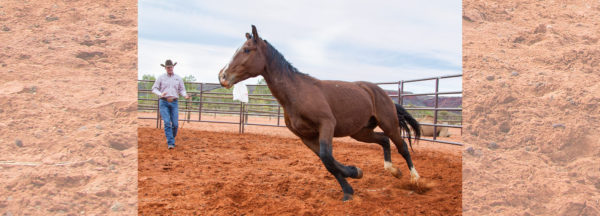
Although it may seem odd, your horse’s responsiveness when you ask him to move forward under saddle (his gas pedal) is established on the ground, beginning with the roundpen exercises. At Fundamentals Clinics, we begin by working with every participant and their horse in the roundpen. I can tell by the way the horses react in the roundpen which ones have a good gas pedal under saddle and which ones don’t. The horses that move off as soon as their owners cue them by pointing their fingers in the air move out well under saddle. The ones that lazily flick a cigarette butt at their owners have the same attitude when it comes to riding. That’s why we get that behavior sorted out and corrected on the ground before we even get in the saddle.
Even if you think your horse has a good gas pedal on the ground—he moves forward when you cue him—you should test him every once in a while to be sure there isn’t any stickiness in his feet. For example, if you’re working on Lunging for Respect, when your horse is cantering around the circle, point up in the air and ask him to speed up. A horse with a good gas pedal picks up his pace while a horse with a sticky gas pedal will flatten his ears and kick out. Horses get good at fooling us and put in just as much effort as necessary to keep us happy, but when you start testing your horse, you might be surprised by what you find.
