Training Tip: First Saddling Success Tip
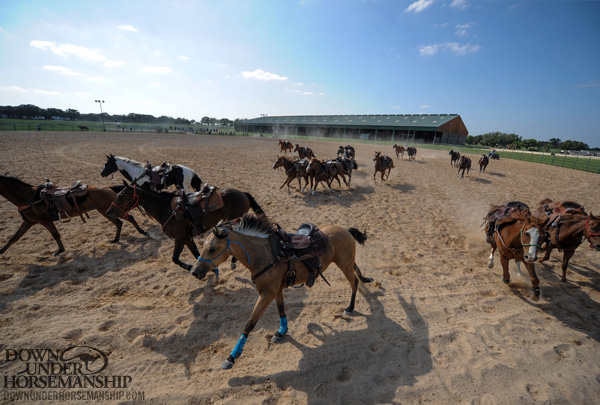
The key to successfully introducing the saddle to a colt is to get his feet moving forward and to give him time to get comfortable wearing the saddle. A lot of horses will stand calmly while you do up the cinches, but once they start moving and feel the cinches pulling on their bellies and flanks, they come unglued. If the colt is going to buck, you want him to buck as hard as he possibly can to try to get the saddle off his back. He needs to realize that he cannot get rid of the saddle or the pressure around his belly. One of the best ways I’ve found to accomplish that is to turn the colt out in a safe arena to let him wear the saddle for several hours. It’s important to turn him out in a large arena so he has room to move his feet. A roundpen is too small.
What usually happens is the colt will run around bucking and then he’ll settle down. Then the stirrup will touch his side or he’ll relax and fall asleep, and when he wakes up he’ll see the saddle on his back and take off snorting and bucking again. You never want to take the saddle off until he is absolutely convinced that he can’t get rid of it and it’s not going to harm him. You have to let him wear the saddle long enough so that it just becomes second nature to him.
